How to Start Forex Trading in 2026 with a Systematic Market-Based Approach
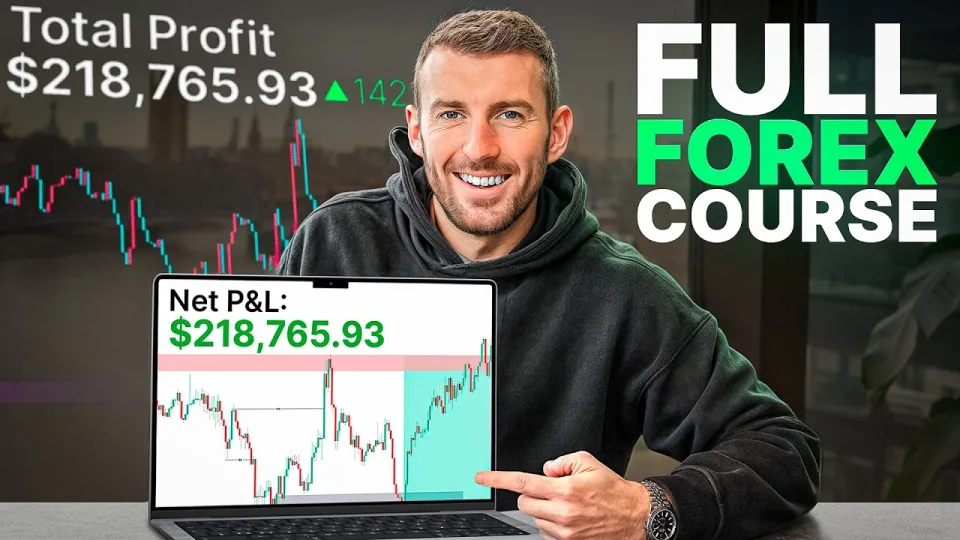
Video: Beginners Guide To Forex Trading In 2026 (+3 hours)
You can order the same kind of articles for your own video to boost it on YouTube and Google. Just message the Telegram bot @sat_sit_bot. The bot writes and publishes the articles itself (with your YouTube video embedded) on popular topical websites (no ads). Your first 50 articles are free.
· based on the channel Matt Donlevey - Photon Trading
Forex is the trading of currency pairs on an over-the-counter market, and the practical way to start in 2026 is to learn how orders actually move price, then build one written, testable strategy around that logic instead of collecting chart patterns. A step-by-step foundation of this kind is what Matt Donlevey - Photon Trading lays out in a long-form beginner course, and the free Photon Trading course plus cheatsheets is available at the Photon Trading training page. The material is free, timestamped by topic, and built around market dynamics rather than geometric shapes.
What forex trading actually is and why patterns fall short
Forex trading means buying one currency while selling another, so every position is a view on a pair such as EUR/USD, GBP/JPY or AUD/NZD. Prices are quoted with a bid and an ask, the difference between them is the spread, and that spread is the first cost every trade pays. Because currencies trade over the counter across a global network of banks, brokers and liquidity providers, there is no single exchange order book that explains everything — but there is still a mechanical reason why price moves: aggressive buyers lift offers, aggressive sellers hit bids, and resting liquidity absorbs or fails to absorb that flow.
The course opens by arguing that technical analysis deserves its poor reputation when it is reduced to triangles, flags and head-and-shoulders shapes. A chart pattern does not explain why anyone would transact at a given price. What does explain it is the interaction of market participants, the location of pending orders, and the auction process that seeks areas where buyers and sellers are willing to do business. If your strategy is built on shapes alone, you are trading a drawing; if it is built on order flow and liquidity, you are trading a mechanism.
The market mechanics every beginner should understand first
The building blocks are microstructure, the order book and auction market theory, and they matter more than any indicator. A few concepts do most of the work:
- Bid, ask and spread. The ask is what you pay to buy, the bid is what you receive to sell, and the spread is the immediate cost of entering and exiting. Tight spreads on major pairs and wider spreads on exotic or off-hours trading change the math of a strategy.
- Order book and liquidity. Resting limit orders sit at specific prices; market orders consume them. Large clusters of resting orders create zones where price may react, and thin areas allow price to travel quickly.
- Auction market theory. Price is a continuous auction searching for levels where trade can occur. When the auction finds no opposition, it moves until it does.
- Order flow. The direction and aggression of executed orders reveal whether buyers or sellers are in control at a given moment.
Once these mechanics are clear, chart reading stops being pattern-spotting and becomes a way of locating where other participants' orders and stops probably sit. That is the shift the course pushes beginners toward before any entry rules are introduced.
How much money can you realistically make in forex
Returns in forex are a function of edge, risk per trade and time, not of a fixed salary, and anyone promising a specific monthly percentage is selling something. A trader risking a small, fixed fraction of the account per trade can compound steadily with a modest win rate and a positive reward-to-risk ratio, but the same position sizing produces deep drawdowns during a losing streak. The honest framing is that profitability is a distribution of outcomes over hundreds of trades, and the account balance is the least interesting number in that distribution.
This is also why the course devotes time to trading other people's money. Prop firms and funded accounts let a trader control capital far larger than their own deposit in exchange for passing an evaluation and respecting drawdown rules, which turns risk discipline from a virtue into a contractual requirement. The trade-off is real: profit splits, daily loss limits and consistency rules mean a strategy that survives a personal account may still fail an evaluation if its variance is too high.
Building a strategy on market structure, premium and discount
The core of the system is a repeatable read of structure combined with a framework for where to enter. Market structure describes the sequence of highs and lows that defines trend and reversal; the course separates several structural types so that a trader knows which context they are in before looking for a setup. Premium and discount then answer the question of price: after a directional move, buying in discount and selling in premium improves the geometry of the trade rather than chasing extended price.
Multi-timeframe analysis ties the two together. A higher timeframe sets the directional bias and the meaningful supply and demand zones, while a lower timeframe is used only for timing an entry inside that context. Supply and demand zones are treated as areas where imbalance was created, not as precise lines, and liquidity concepts explain why price often reaches for stops and swing points before continuing. None of this is a signal generator on its own — it is a filter that keeps entries on the right side of the auction.
Entries, management and the costs that decide the outcome
Execution is where a good read becomes a measurable trade, and the course treats it as a checklist rather than a moment of inspiration. An entry needs a defined invalidation point, a target that reflects the structure being traded, and a position size derived from the distance to the stop. Trade management then covers partial exits, moving to breakeven and holding through noise, while money management caps risk per idea and total exposure so that no single trade can damage the account.
Costs deserve the same attention as the setup. Spread, commission and overnight swap quietly reduce expectancy, and a strategy with a small average win can be turned negative by trading an expensive instrument at the wrong time of day. Choosing a broker therefore comes down to regulation, execution quality, raw spreads versus commissions, swap terms, platform reliability and withdrawal process — not to bonus offers. Before risking money, a beginner should know exactly how to place an order, where the stop sits, and what the trade will cost round-trip.
Common mistakes, journaling and the psychology trap
Most beginner losses come from a short list of avoidable errors: risking too much on a single idea, switching strategies after a handful of losses, and trading without a written plan that defines entries, exits and risk. A trade plan turns intent into rules, and backtesting turns rules into evidence — a sample of trades that shows whether the edge exists before real capital is exposed. Journaling then closes the loop by recording the reason for each trade, screenshots, the outcome and the emotional state, so that recurring mistakes become visible.
On psychology, the course takes a position that runs against common advice: master the strategy first. Discipline is much easier to sustain when the process has a demonstrated edge, because the trader is following a tested plan rather than managing the anxiety of an untested one. A viewer with years of study behind them noted learning new material even forty minutes in, and another described the course as a 360-degree view that finally connected structure, risk, planning, journaling and psychology into one picture. That integration, not motivation, is what makes the material usable.
Useful links
- Free Photon Trading course and cheatsheets: https://www.photontradingfx.com/free-training?el=beginnersguide&htrafficsource=YT
- Photon Trading mentorship: https://www.photontradingfx.com?el=beginnersguide&htrafficsource=yt
- Free Telegram channel with analysis, trade recaps and tips: https://t.me/photontrading
- Instagram: https://www.instagram.com/photontrading/
Final thoughts
Forex rewards a trader who understands why price moves, prices risk in advance and measures results over a large sample, and it punishes anyone who treats charts as decoration. The value of this beginner course is its order: market mechanics first, structure and liquidity second, execution and costs third, and psychology last, once there is something real to be disciplined about. Matt Donlevey - Photon Trading delivers the whole sequence in one place, which is why viewers describe it as a full course rather than another highlight reel. Start with the free Photon Trading course and cheatsheets, write a one-page plan, and test it on historical data before placing a live trade.
Key takeaways
- Forex is an over-the-counter market where currencies are quoted in pairs; price moves because of order flow, not because of chart shapes.
- Every trade costs money through the spread, commissions and swap, so costs must be part of the strategy, not an afterthought.
- The Photon approach builds a strategy on market microstructure, auction market theory and liquidity instead of geometric patterns.
- A complete process covers market structure, premium and discount zones, multi-timeframe analysis, supply and demand, entries and management.
- Progress comes from a written trade plan, backtesting, journaling and position sizing — psychology follows once an edge exists.
Source: Beginners Guide To Forex Trading In 2026 (+3 hours) · Markdown version
Questions & answers
Do I need indicators or chart patterns to trade forex?
No. The course argues that geometric shapes do not explain why price moves, and that a strategy should be built on market microstructure, order flow and liquidity instead. Indicators can still be used, but they should describe the same underlying dynamics rather than replace them.
How much capital do I need to start trading forex?
There is no fixed minimum, but the account must be large enough that a sensible risk per trade — a small fixed percentage — is meaningful and survivable through a losing streak. Funded accounts and prop evaluations are an alternative route to controlling larger capital, though they add drawdown and consistency rules.
Is a three-hour beginner course enough to become profitable?
A long course can cover the full process — mechanics, structure, entries, risk, costs, broker choice and journaling — but profitability comes from applying and testing it. Backtesting, a written trade plan and a journal of real trades are what convert the material into an edge.
Why does the course put trading psychology last?
Because discipline is easier when the process has a demonstrated edge. Mastering the strategy first gives the trader a tested plan to follow, which reduces the emotional pressure that makes psychological mistakes so common in the early stages.